If you’ve ever stood at the base of a climb, looked up, and thought “I want to do this… but how?”—this manual was written for you.
The Virginia Triple Crown is one of the most iconic hiking challenges on the East Coast. It’s breathtaking, humbling, and demanding in ways that don’t always show up on a mileage chart. And while the views get all the attention, what really determines success is preparation—physical, mental, and practical.
That’s why I created the Couch to Triple Crown Manual: a realistic, progressive training guide designed to take you from “I hike sometimes” (or “I used to”) to standing on those cliffs strong, steady, and confident.
What Is the Virginia Triple Crown, Exactly?
The Virginia Triple Crown refers to three Appalachian Trail hikes clustered in southwest Virginia. Each trail offers its own personality—and its own challenges.
McAfee Knob
- Distance: ~8 miles out-and-back
- Elevation Gain: ~1,700–1,800 feet
- Trail character: Well-maintained with steady climbing
- Why it’s iconic: One of the most photographed overlooks on the entire Appalachian Trail
Dragon’s Tooth
- Distance: ~4.5–5 miles out-and-back
- Elevation Gain: ~1,200–1,300 feet
- Trail character: Steep, technical, hands-on scrambling with ladders and rock gaps
- Reality check: Comfort with exposure matters here more than speed
Tinker Cliffs
- Distance: ~7.5–8 miles out-and-back
- Elevation Gain: ~1,600–1,800 feet
- Trail character: Long climbs and extended cliff-lined ridge walking
- Why it’s special: Sustained views that reward patience and endurance
Doing All Three: One Loop, Big Commitment
Many hikers choose to tackle the Triple Crown as a single continuous loop, connecting all three trails via the Appalachian Trail and surrounding connectors.
- Total Distance: ~34–36 miles
- Total Elevation Gain: ~9,000–10,000 feet
- Typical Time on Trail: 18–24+ hours for a single push
- Terrain: Rocky tread, repeated climbs, technical scrambles, and long ridgelines
Even when completed over multiple days, the cumulative fatigue adds up quickly. This is not just “three hikes.” It’s an endurance challenge that requires durability, judgment, and mental resilience—especially when conditions change.
Why This Manual Exists
This is not a “just push through it” plan.
The Couch to Triple Crown approach is built around:
- Progressive training phases that respect where you’re starting
Comfort-based readiness markers instead of arbitrary timelines - Injury prevention, recovery, and sustainability
- Skill development that keeps you safe when things get hard
- Mindset tools for fear, fatigue, and self-doubt
You won’t find six-week shortcuts here. You will find a framework that helps you show up prepared—and enjoy the process of becoming capable.
What’s Inside the Couch to Triple Crown Manual
This manual is designed to be printed, highlighted, dog-eared, and revisited as your skills and confidence grow.
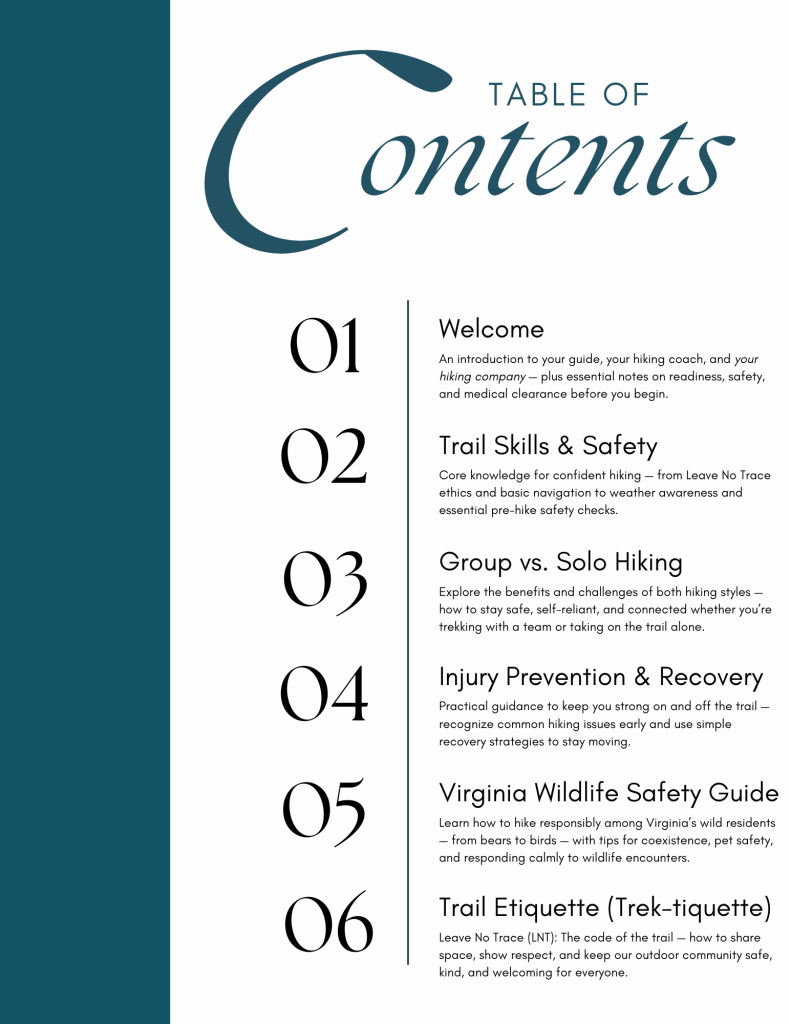
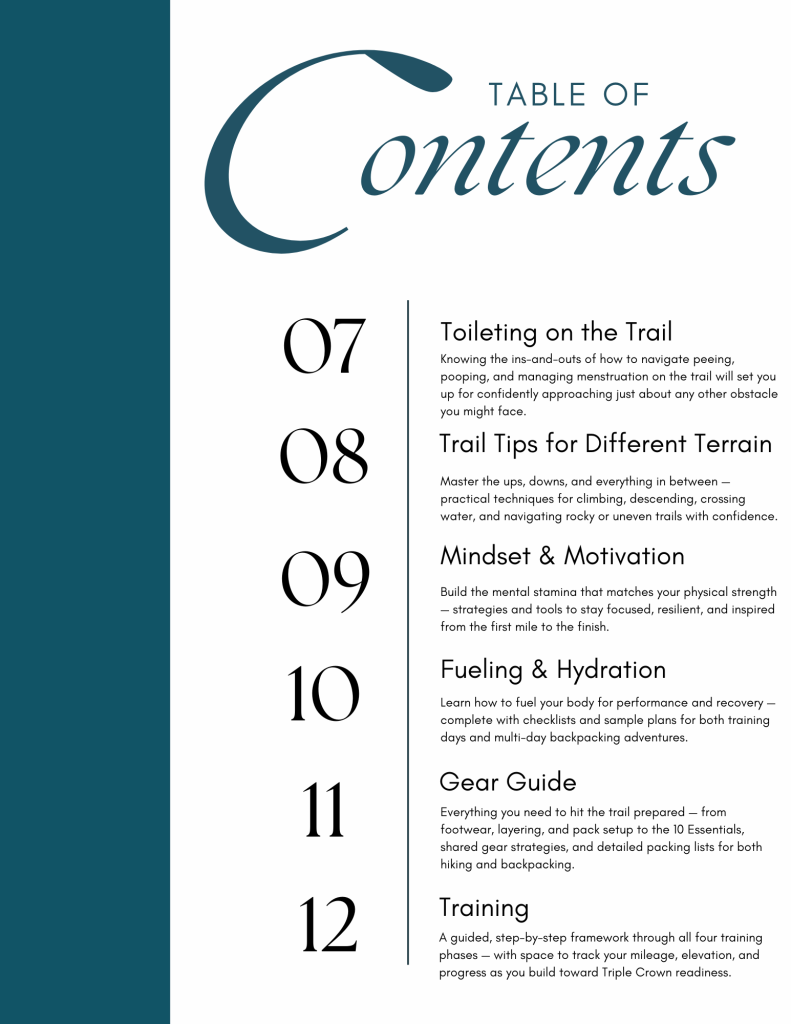
Table of Contents
- Welcome
- Trail Skills & Safety
- Group vs. Solo Hiking
- Injury Prevention & Recovery
- Virginia Wildlife Safety Guide
- Trail Etiquette
- Toileting on the Trail
- Trail Tips for Different Terrain
- Mindset & Motivation
- Fueling & Hydration
- Gear Guide
- Training
Each section can stand alone, but together they build a complete picture of what it means to move through wild places competently and responsibly.
How to Use This Manual
This is not a cover-to-cover, one-weekend read. It’s a working system.
1. Learn the Skills
Start with trail safety, etiquette, wildlife awareness, self-care, and terrain-specific tips. These are the foundations that keep a hard day from becoming a dangerous one.
2. Train
Use the training guidance to gradually build mileage, elevation tolerance, and comfort with a weighted pack. The goal isn’t speed—it’s durability and consistency.
3. Evaluate Readiness
Throughout the manual, you’ll find clear “move on vs. hold steady” checkpoints. Progression is based on how comfortably you complete the work—not on the calendar. Holding steady is not failure; it’s smart training.
4. Explore Side Quests
Training doesn’t have to be linear or boring. The manual encourages exploration—local trails, state parks, stair workouts, and curiosity-driven adventures that build fitness and deepen your connection to place.
Watch the Companion Video
Alongside the printable PDF, here is a NotebookLM video walkthrough where “I” talk through the intent behind the manual, how to adapt it to your life, and how to know if you’re truly ready to move forward.
If you’re someone who likes context, reassurance, and hearing the “why” out loud, the video is there to support you.
https://www.youtube.com/watch?v=WhB6S-izEsU
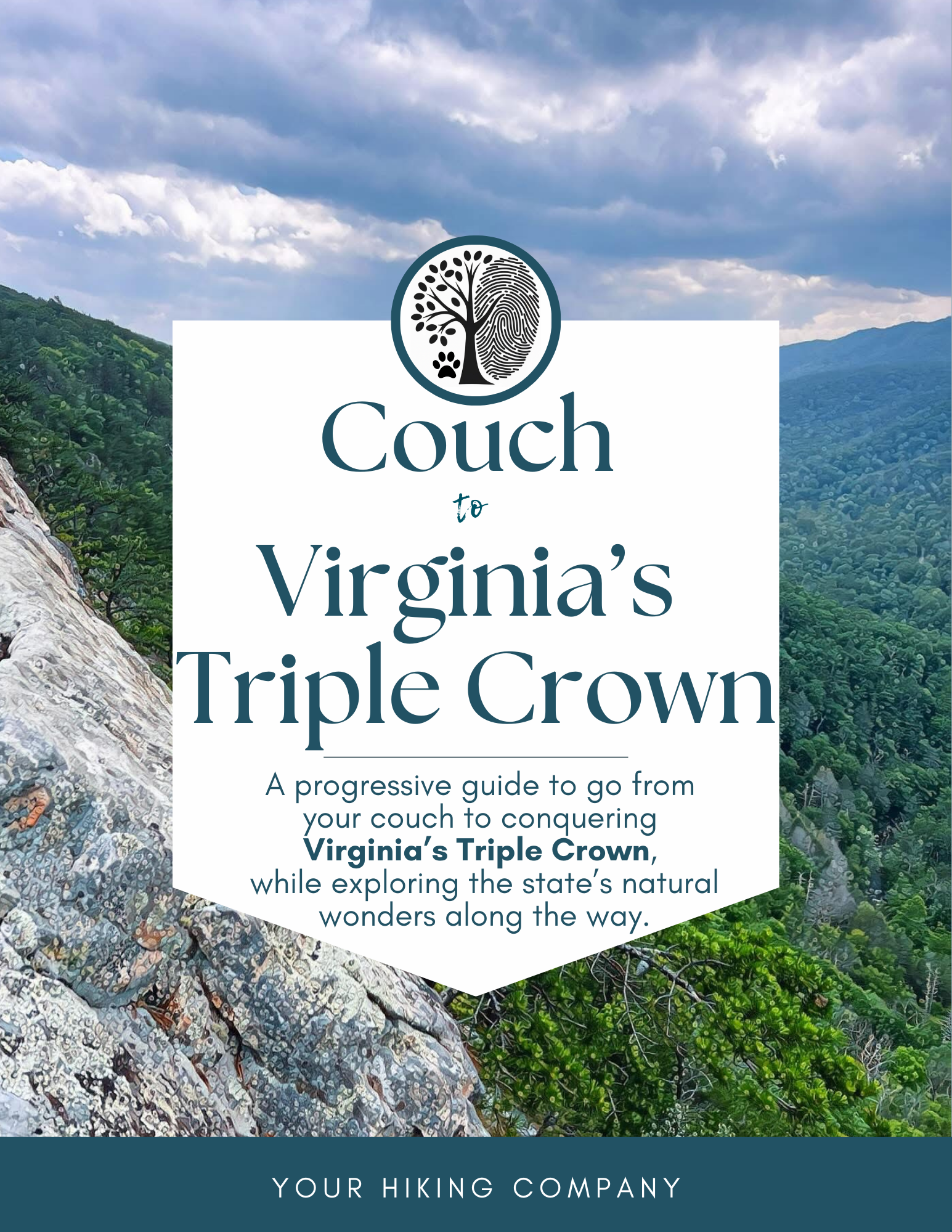
NotebookLM definitely poached one of my photos from when I went rock climbing at Annapolis Rocks instead of from one of the Triple Crown summits for the cover photo – and it made me into a beautiful black women – a reward for never posting photos of myself, I suppose!
Who This Manual Is For
This guide is for:
- Hikers returning after time away
- Runners transitioning into long-distance hiking
- Women carrying full lives who still want big adventures
- Anyone intimidated by elevation, exposure, or endurance goals
It is not a weight-loss program.
It is not a race.
And it is absolutely not about proving anything to anyone else.
This is about building trust—in your body, your skills, and your ability to make good decisions on trail.

The Training Approach Behind Couch to Triple Crown
At the core of the Couch to Triple Crown Manual is a four-phase training framework designed to be progressive, flexible, and realistic for real life.
The phases build intentionally—layering fitness, skills, and confidence—so you’re not just logging miles, but actually becoming more capable on trail.
Training progresses from building basic hiking consistency and light pack comfort, to increasing elevation tolerance, strength, and durability. By Phase 3, the focus is on preparing to complete the Virginia Triple Crown as day hikes. For many hikers, this is the goal—and the finish line. If backpacking isn’t part of your plan, there’s no need to progress further.
Phase 4 is there for those who do want to backpack the Triple Crown, adding heavier pack weight, multi-day fatigue, and recovery between long efforts. The structure allows you to stop confidently where your goal ends—without pressure to do more than you need.
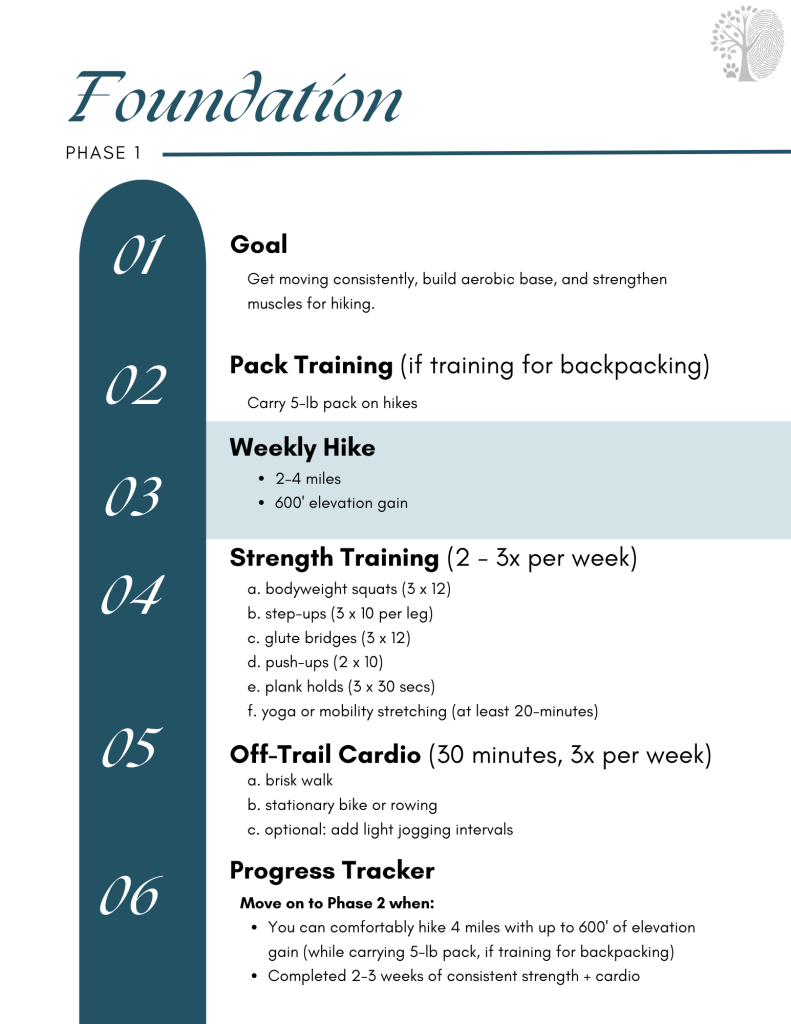
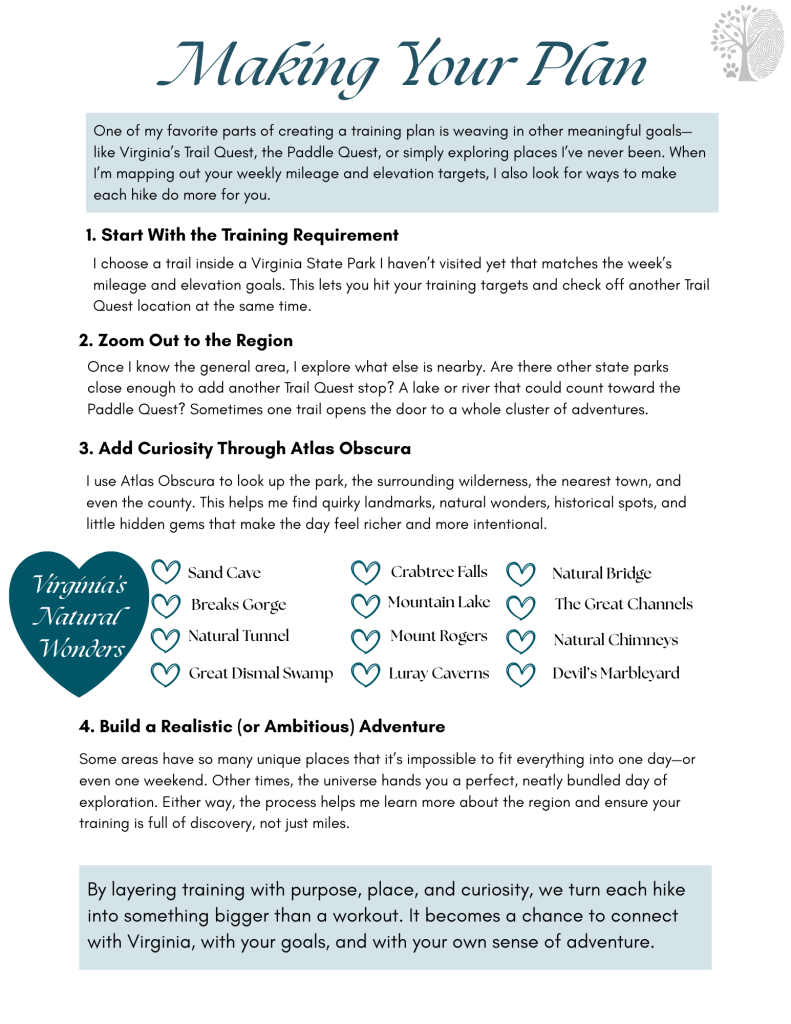
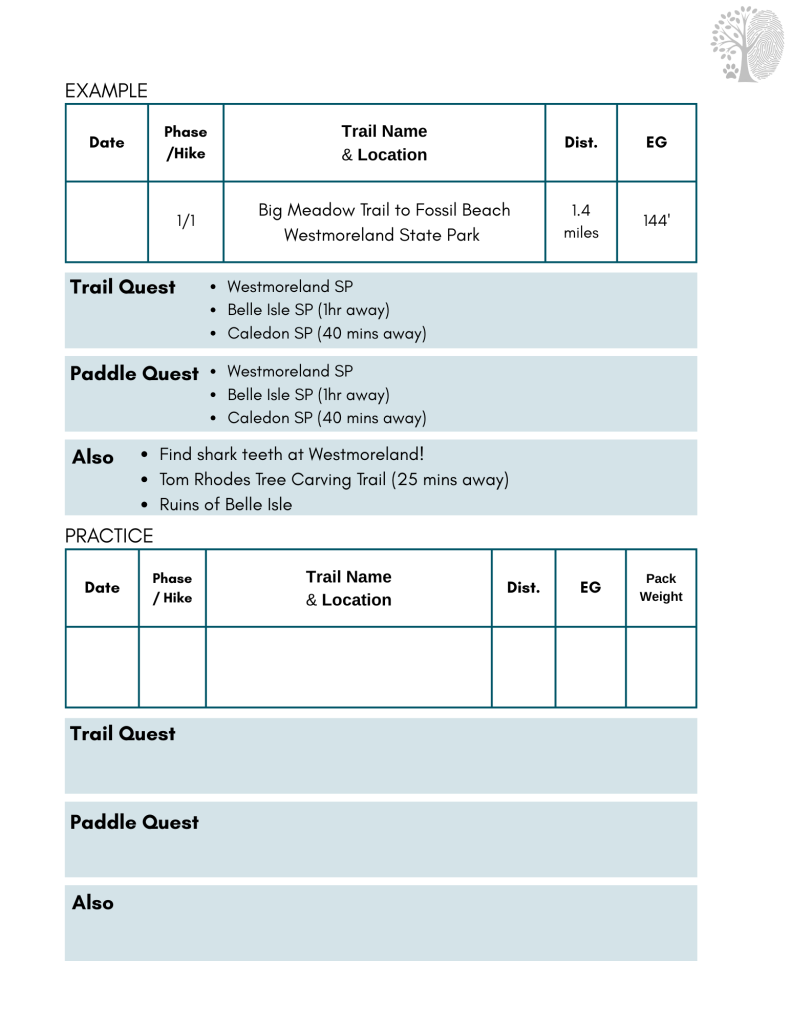
Across all phases, the principles stay the same. Pack weight increases gradually to build strength without overwhelming your body. Strength training is included throughout, focusing on legs, hips, core, balance, and joint durability—while intentionally minimizing extra equipment. Most workouts can be done with bodyweight, a backpack, stairs, or everyday household items.
You won’t find a list of prescribed trails or rigid schedules. That’s intentional. The goal is to teach you how to train yourself, adapt the plan to what’s accessible where you live, and build confidence in choosing appropriate hikes based on your current phase—not someone else’s geography.
To keep training engaging, the manual encourages making each hike more by weaving in exploration and meaning—visiting new parks, chasing views or history, participating in Virginia’s Trail Quest or exploring Virginia’s Natural Wonders, and turning long efforts into “perfect day” adventures. Fitness still improves, but so does your connection to place.
Throughout the process, worksheet templates support reflection and decision-making—helping you track mileage, elevation, pack weight, comfort, and readiness, and decide when to move forward or hold steady. Because preparation isn’t just physical; it’s awareness, judgment, and trust in yourself.
Whether your Triple Crown happens this year, next year, or simply lives on your horizon for now—this manual is designed to meet you where you are and walk with you toward it.
I believe in slow strength.
I believe in preparation.
And I believe you belong on those summits.